Showing posts with label First Nations. Show all posts

Monday, November 3, 2025

Free Tribal Lands Map

Photo from PBS Wisconsin
If any of you were at the Wisconsin Library Association annual conference last week, you may have seen the Tribal Lands Map that Cassy Leeport shared during her wonderful keynote Friday morning. 

Did you know your library can get a free copy of that map from PBS Wisconsin? Simply fill out this form and they'll send you one. 

PBS Wisconsin has a wealth of information about Wisconsin's First Nations for you to explore here.

Thursday, February 29, 2024

Maad Online Book Club


Wisconsin Sea Grant, in partnership with the Great Lakes Indian Fish and Wildlife Commission (GLIWFC), has created a monthly book group for teachers, parents and librarians (anyone who loves to read with children) focused on Ojibwe Culture and the Great Lakes. The book club is open to anyone in the Great Lakes region who wishes to join. Each month’s discussion includes an Ojibwe honored guest who shares wisdom and stories based on the theme of the book.

Visit: go.wisc.edu/Maadagindan to see the recent titles and send an email to Anne Moser akmoser@aqua.wisc.edu to join the email list. 

Friday, January 26, 2024

Two New Books in Menominee Language

Thanks to the NFLS News newsletter January 2024 for the heads up on these two new books published for children in the Menominee language. What a great resource for our WI libraries!

Have you Heard About the Frybread Man?


"S. Verna Fowler Academic Library/Menominee Public Library" sign at the front entrance of the libraryThe Menominee Indian Tribe of Wisconsin received a $149,889 grant from the Institute of Museum and Library Services (IMLS) to create and self-publish a series of books to encourage fluency in and preserve the Menominee language. Library staff worked with a trained immersion teacher to create several children’s books with phonetic pronunciation and English translation for juvenile readers. The goal of these books is to create a series of books for young readers and their families to learn Menominee vocabulary words together.

The first two books (shown below) are available on Amazon and will be provided to families with infants attending the immersion rooms at the Menominee Tribal daycare, elementary children attending reservation schools, and those visiting the library.


book cover of "Count with Me in Menominee: Read with Me in Menominee Series"Count with Me in Menominee: Read with Me in Menominee Series
by S. Verna Fowler Academic Library (Author), Janice Rabideaux (Illustrator) 

Learn to count in Menominee with hand drawn images of local animals and their babies. A great book for counting, language learning, and early literacy.

This book was developed as part of the Institute of Museum and Library Services. The goal of these books is to create a series of books for pre/early readers and their families to enjoy together. Each book features Menominee vocabulary words to help the readers learn together. Waewaenen/thank you.


book cover of "The Frybread Man"The Frybread Man
by Carlotta Perez (Author), Mona Lyons (Author)

If you love the Gingerbread Man you are going to love the Frybread Man. In this book the Frybread Man takes off on the old woman and her husband and runs from animals he meets in the forest in this woodland version of the classic Gingerbread Man.This book is designed to teach young readers and their families Menominee language words and how to say them with a pronuncian key at the beginning of the book and phonetics by each word.

The College of Menominee Nation Library also posted a Zoom video featuring a reading of The Frybread Man by Cedar Fernandez and songs sung by Wade Fernandez on its Facebook page on October 1, 2020.

The Menominee Public Library is located on the College of Menominee Nation campus in Keshena, Wisconsin, now called the S. Verna Fowler Academic Library/Menominee Public Library. In late 2012, the Menominee Tribal/County Public Library created a joint library with CMN’s academic library to serve the Menominee community. The Library plans to publish more books in the Menominee language in the near future to continue to teach and preserve the language.

Tuesday, January 16, 2024

Wisconsin First Nations Booklists


There are a number of booklists for children and teens that are available for free on the Wisconsin First Nations American Indian Studies in WI website. These recently updated booklists are divided into books for Grades K-2; 3-5; 6-8 and 9-12. These booklists are authored and made available collaboratively between DPI, PBS Wisconsin, UW-Madison School on Information with the CCBC and Teachingbooks.

You can find them here.

"Discover books for teaching and learning about the American Indian Nations of Wisconsin. Consult the Tribal Lands Map to explore whose tribal lands and which nations are located closest to your school. Contact your school or local public library to check out any of the books. For more information, book titles are linked to either the Cooperative Children’s Book Center (CCBC), the University of Wisconsin-Madison School of Education examination, study, and research library; or TeachingBooks, a resource provided to Wisconsin educators through Badgerlink, Wisconsin’s online library."

There are additional great resources on this website including informational books for educators, teaching about WI First Nations, tribal maps, tribal histories, print and media on First Nation customs and biographies and much more.

Thanks to PBS Wisconsin for alerting us to these resources.

Tuesday, January 9, 2024

Late-breaking News: Ojibwe Storytelling Series

As seen in the January 4,2024  Keeping Up with Kids blog:


Free and virtual Ojibwe storytelling series

In Ojibwe culture, winter is storytelling season!  In celebration, the Wisconsin Historical Society is again bringing four traditional Ojibwe storytellers virtually via Zoom, to people around Wisconsin. This series is free and open to the public, but registration is required. The sessions will be held Tuesday evenings, January 9-30, 2024 from 7:00 – 8:00 pm. 


Our storytellers include:

  • Sirella Ford from Lac Courte Oreilles on January 9
  • Tina Van Zile from Sokaogon (Mole Lake) on January 16
  • Tinker Schuman from Lac du Flambeau on January 23
  • Liz Arbuckle from Bad River on January 30. 
You can learn more about the storytellers and register via our webpage at: https://wihist.org/OjibweStorytelling  This is our third year of hosting an Ojibwe Storytelling Series. All of the previous storytelling events have been recorded and can be accessed via the Storytelling webpage. These are also free and available to the public.  (from Reb, Here’s a flyer pdf to download.)

Please let me know if you have any questions and I hope you can join us this month.

Miigwech,
Liz Arbuckle
Northern Outreach Coordinator, Wisconsin Historical Society
Northern Great Lakes Visitor Center, 29270 County Highway G, Ashland, Wisconsin 54806
(715) 685-2667    liz.arbuckle@wisconsinhistory.org

Monday, October 12, 2020

Indigenous People's Day

Map of Wisconsin First Nations — Treaty lands in 1800 and present-day tribal lands

 From the Wisconsin Historical Museum:

Today is Indigenous Peoples' Day!
The place we now call Wisconsin is the ancestral land of many Native nations who call this place home, and we are honored to be a place of stories, memory, and living tradition for all. Today, Wisconsin is home to twelve Native nations.
Indigenous people are an inextricable part of Wisconsin’s past and present, and yet, in so many damaging ways, they have been missing from the stories we tell. There are no references to Indigenous people on our state flag, for example. We too often talk about pioneers coming to this state without acknowledging the violent removal of Indigenous people that made European immigration possible. And often history lessons fail to communicate that people of Native Nations are not just part of the past — they are a crucial part of Wisconsin today!
We take this day to acknowledge the Indigenous people of Wisconsin, the past, current, and future stewards of this land we stand on.
To learn more about American Indians in Wisconsin, check out https://wisconsinfirstnations.org/

Saturday, October 3, 2020

Rethinking Thanksgiving at the Library

As the fall holiday season begins, it's good to think about how to provide service in a more inclusive way with our collections and how we spotlight Native voices. This 2018 article by Dr. Debbie Reese has some great suggestions.

To read the whole NCTE (National Council of Teachers of English) blog post, please click here.

Monday, March 11, 2019

New Resource Manual - American Indian Studies in WI

Robin Amado, part of the FB group Wisconsin Librarians and Teachers Supporting Act 31, recently shared an advanced printing of amazing resource for all of Wisconsin staff working with children: American Indian Studies in Wisconsin (Act 31) Resource Manual compiled and written by Caryl Pfaff, librarian at the Lac Courte Oreilles Ojibwa Community College Library in Hayward WI.


The need to educate WI residents by sharing accurate information about tribal histories and culture led in 1989/91 "to the creation of Wisconsin Act 31 that requires all students and teachers within the state of Wisconsin receive instruction on the history, culture, and tribal sovereignty of the American Indian nations and tribal communities in Wisconsin. This instruction is required for students at least twice in the elementary and once in the high school grades. This resource manual has been developed to help teachers, students, librarians, and parents identify quality materials that will help support Act 31 endeavors."

This resource guide, funded by an IMLS grant, shares information, curriculum and booklists for elementary and secondary age youth on both WI tribes and those outside of WI. There are acquisition sources for materials listed in the 66 page manual as well as a wide array of information of use to libraries of all types throughout WI. This resource is a treasure trove for collection development for all ages in libraries!

Tuesday, November 20, 2018

November is Native American Heritage Month

As librarians, we know how important it is that kids see themselves in books--and see others in books, as well.  #weneeddiversebooks, aimirite?! 

When is the last time you assessed your collection for books/titles containing Indigenous characters?

“Most of what kids see in books today are best sellers & classics that stereotype & misrepresent Native people in history. There’s a lot of bias in them. The books that I recommend are ones that can counter that bias in several ways. One, they’re not stereotypical. Two, most of them are set in the present day, which is important in countering what we see in a lot of children’s & young adult literature, which says that we vanished, we didn’t make it to the present day, and of course we did.” 
     - Debbie Reese, Nambe Pueblo, of American Indians in Children’s Literature

At this year's WLA, Valerie Morris of Whitefish Bay Public Library presented on just such a topic during her session, Experiences in Weeding Insensitive Picture Books About Native Americans.  The PowerPoint about the presentation is now available on the WLA website--and through THIS LINK.

Perhaps you're looking for more books written and/or illustrated by Indigenous people to help enhance your collection?  Try the blog American Indians in Children's Literature!  Or take a gander at this delightful booklist containing titles for children written by Indigenous authors.


For an idea how best to select and utilize these titles in your programming/classrooms/what-have-you, be sure to check out the following article from the July 2018 edition of Language Arts written by Debbie Reese: Critical Indigenous Literacies: Selecting and Using Children’s Books about Indigenous Peoples.  

Here are a few other online resources to explore:

National Congress of American Indians
Wisconsin First Nations: American Indian Studies in Wisconsin

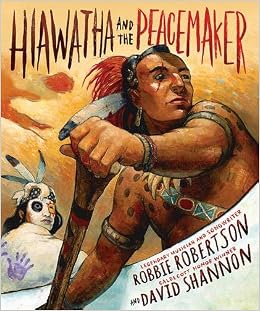
 Image result for hiawatha the peacemaker

Tuesday, October 31, 2017

Thinking About Your Library's Thanksgiving Collection

With the spotlight on diversity and inclusion, November is a good time to take a look at your library's Thanksgiving collection. It may be time to select new materials that reflect Native American perspectives on Thanksgiving, evaluate and deselect materials that are outdated, biased, inaccurate or misrepresentative. As you create displays or hang posters, consider what you are showing and who might be seeing it.

Resources you might want to use:

Debbie Reese's 2009 article on American Indian Perspectives on Thanksgiving 

Debbie Reese's 2014 article about Oyate's List of Books to Avoid, as well as books Debbie recommends

The educator's page at the National Museum of the American Indian (NAMI) website

American Indian Library Association book reviews page

Oyate's website where you can find book reviews, resources, workshops, and criteria for evaluating books for anti-Indian bias

The paper "I is for Inclusion: The Portrayal of Native Americans in Books for Young People" which covers background, evaluation, and sources for books among other things.

The Resource List from the WLA Preconference Representation, Authenticity, and Being Real: Diversity in Youth Services presented by Anna Haase Krueger and Tamara Lee of the Ramsey County Library, MN 

This list is by no means exhaustive, so please share your resources or suggestions in the comments.  

Friday, February 26, 2016

CCBC Multicultural Statistics for 2015

Continuing an annual effort of over 30 years, the CCBC documented the books they received in 2015 that are created by or are about people of color or from First/Native Nations.  Some numbers are up slightly from last year, but from the past it is known that a slight upward fluctuation is not necessarily sustained in subsequent years. 

Check out some of the numbers:
  • 261 books had significant African or African American content
    • 86 of these were by Black authors and/or illustrators
  • 100 books were by Black book creators
    • 14 of these had no visible African/African-American cultural content  
  • 41 books had American Indian / First Nations themes, topics, or characters
    • 17 of these were by American Indian/First Nations book creators
  • 18 books were by American Indian / First Nations authors and/or illustrators
    • 1 of these had no visible American Indian/First Nations content
  • 111 books had significant Asian/Pacific or Asian/Pacific American content
    • 43 of these were by Asian/Pacific or Asian/Pacific American 
  • 173 books were by authors and/or illustrators of Asian/Pacific heritage 
    • 130 of these had no visible Asian/Pacific or Asian/Pacific American content
  • 82 books had significant Latino content 
    • 40 of these were by Latino/a authors and/or illustrators
  • 57 books were by Latino/a authors and/or illustrators
    •  17 of these had no visible Latino content 
Explore the rest of this intriguing discussion HERE.