Showing posts with label teen. Show all posts

Tuesday, November 4, 2025

Youth Programming Workshop in Madison


The annual South Central Library System (SCLS) Youth, Teen, & Tween workshop will be held next Thursday, November 13 from 9:30 AM - 3:30 PM, and you and your colleagues are invited to attend! The event will be held at Olbrich Gardens, 3330 Atwood Avenue, Madison. 

Here's the schedule for the day:

9:00 - 9:15 AM Coffee & Conversation


9:15 AM - 12:00 PM  


The Library as Time Machine: Using Historical Fiction to Create Library Programs for Youth 

Presenter: Eileen Schnabel, author of the Kep Westguard historical fiction series


Eileen will introduce ways that libraries can use historical fiction to engage communities, foster intergenerational learning, and build partnerships. Attendees will gain practical strategies for implementing history-themed programs, hosting immersive events, and using storytelling to inspire lifelong learning. This workshop will provide actionable tools to help libraries connect readers with history in creative ways while strengthening their role as community hubs.


12:00 - 1:00 PM  Lunch & Networking   


Lunch will be the Taco Bar ($15) from Cranberry Creek and includes gluten-free and vegetarian options. You may also bring your own lunch (no refrigerator available). Libraries will be invoiced after the event.


1:00 - 3:30 PM  


Unearth the Stories Beneath Our Feet: Homegrown Programs for Teens and Tweens

Presenter: Shawn Brommer, SCLS, and Friends


Shawn Brommer and colleagues from across the system will share program suggestions, activity examples, book-centered programs, and other ideas that libraries can implement during the summer of 2026 and into the future. By focusing on concepts of the past, present, and future, earth science, alternative histories and futures, and other innovative themes, participants will leave the workshop with program ideas and step-by-step instructions for programs that teens and tweens will DIG.


Register here!

Wednesday, September 3, 2025

Teenagers in Groups Webinar

Ryan Dowd's Working with Teens webinar series finishes up this month with the third installment!

Teenagers (Part 3): Teenagers in Groups

Date & Time: Thursday, September 11 at 1:00 PM (Central) 

Description:

    • Why teens behave differently in front of other teens
    • Why teens feel less responsible for their actions when in a group
    • Eight strategies you can use to manage teen group behavior

Register here.

Be sure to check out the other parts of the series as well!

Teenagers Part 1: Basics of Teenage Behavior may be found here. It covers:

  • Why teens test boundaries (and what you should do about it)
  • How “respect” works with teenagers
  • Two things you should NEVER do when dealing with teens

Teenagers Part 2: Teens with Trauma/ACES may be found here. It covers: 

  • Types of Adverse Childhood Experiences (ACEs) teens can experience
  • Impact of trauma on the brain (and their behavior)
  • Five tools for working with teens with trauma/ACEs

Wednesday, July 30, 2025

Working with Teens Webinar Series

If you are just starting out in Teen Services, looking for some best practices, or seeking information to share with other staff members - I highly encourage you to check out Ryan Dowd's 'Teenagers' webinar series on Niche Academy (accessible to Wisconsin librarians through Wisconsin Department of Public Instruction).

All staff that interact with teens would benefit in viewing the introductory webinar as it goes through teen brain development, how teens view/react to situations differently, how to set/enforce boundaries, and how to build a relationship with teens that leads to better outcomes.

The first part of the series Teenagers: Basics of Teenage Behavior may be found here.

Teenagers Part 2: Teens with Trauma/ACES will be held on Thursday, August 14 from 1-2 PM (Central Time). The topics covered will include:

  • Types of Adverse Childhood Experiences (ACEs) teens can experience
  • Impact of trauma on the brain (and their behavior)
  • Five tools for working with teens with trauma/ACEs

You can register for this webinar here

Wednesday, July 2, 2025

Camp Reads for Teens

Image by Nicole Turner from Pixabay
Nothing says summer like summer camp. So many memories are made through the fireside heart to hearts, s'mores, games, and of course time away from home. We've all had request for beach reads, but may I suggest introducing camp reads into your  reader's advisory with Dena McMurdie's list of must-read YA books set at summer camp.

McMurdie explains, "For many teens, sleepaway camp is their first time away from home and the watchful eyes of their parents — which is why novels set at summer camp are filled with coming-of-age themes. Spending time away from home, connecting with friends, and experiencing new things are excellent reasons why sleepaway camp is a rite of passage for many young people."

Stop here to see the list! [Highly Readable YA Books Set at Summer Camp. Dena McMurdie. Brightly blog. Undated.]

Wednesday, May 28, 2025

May the Odds Be Ever in Your Favor with Hunger Games Programming

With the release of the newest Hunger Games book, Sunrise on the Reaping by Suzanne Collins, the dystopian series is back in the spotlight (thought it never really left it) and it's a great time to host a Hunger Games program for teens! 

Cindy Shutts has you covered in her recent post on the Teen Librarian Toolbox. Compiling programs and activities across a couple libraries, she writes, "This series of programs was a success and I hope we can do more programming like this in the future. Teens seemed to be excited about the programs and overall was very well received! It made it easier to advertise and get kids excited to come."

The post details crafts like a mockingjay paint along and Hunger Games pendants as well as other activities like trivia and survival knot tying.

Stop here to read the whole post.  [Cindy Crushes Programming: Hunger Games Week, a celebration of the Dystopian series still thrilling teen readers. Cindy Shutts. Teen Librarian blog. May 21, 2025.]

And if you are still looking for Hunger Games ideas check out Karen Jensen's suggestions from 2011 here. [Feed Their Hunger for the Hunger Games. Karen Jensen. Teen Librarian Toolbox blog. July 19, 2011.]

Tuesday, April 22, 2025

Recipe for a Teen Program

The Teen Librarian Toolbox dishes up another teen program this time with a focus on recipes!  In the recent post, Karen Jensen pitches a recipe preserving program where tweens and teens can save family recipes through personalized recipe cards. She writes, "This isn’t the typical type of program I put together for tweens and teens, it has a lot of nostalgia built into it. But I have often found that our tweens and teens are yearning for connections and traditions in ways that we often overlook, and this is an unique way to meet that need."

She suggests different ways to present the program besides focusing on family (emphasizing nutritional literacy or rolling it into an Adulting 101 series) and provides Canva templates for the recipe cards.

If the teens at your library are anything like mine (and I know they are), they are all about food during programs.  I'd serve this program up with an easy recipe they can make during the event. Have access to a microwave?  Make mug cake! Got a griddle or waffle iron?  Great time to bring it out! Only have an electric kettle?  It makes pretty good ramen!

Let us know if you try out this program!

Stop here to read the full post [MakerSpace: Preserving Family Recipes in the Library, Karen Jensen. Teen Librarian Toolbox blog. April 21, 2025.]  

Tuesday, April 8, 2025

It's a Hit! Musical Bingo!


Musical Bingo is a fun twist on the classic game using song titles in place of letters and numbers. And I can’t recommend it enough as a low-cost and low-prep teen program.

I hosted my first Musical Bingo for teens last summer after seeing a post about it on the Teen Services Underground Facebook page by Megan Reddin. She details how she runs the event (coming up with themes, compiling a playlist, creating bingo cards, and gathering prize options).


Since running the program last year, my teens have requested Musical Bingo over and over again. We have a weekly Wednesday teen program and Musical Bingo has become a regular in our rotation of activities. While I usually get between 15–22 teens a week, I find that Musical Bingo will draw in teens that don’t normally attend or participate in the organized activities. 


Example Musical Bingo sheet


I’m always shocked by the songs they know, and it’s incredibly wholesome when the whole room starts singing along.  Their excitement for Musical Bingo continues to surprise me. After our last game, they asked if they could start compiling a list based on their favorite songs. Absolutely, they can 😊


For our next game, all the song lists will be put together by the teens, and I’ll make the boards and provide the prizes. Naturally, a sing-along will break out and fun will be had by all! 


Let us know if you try it out in your teen programming!


To read more about Musical Bingo, visit the Megan's original post on the Teen Services Underground Facebook group.


Wednesday, February 1, 2023

Teen Librarian/Teen Services Librarian Meet-Up on February 13th


Teen Librarian/Teen Services Librarian Meet-Up on February 13th from 11:30 AM-12:30 PM

"All Together Now! Let's talk about Teen Services and SLP!" 

Jump in and connect with other Young Adult/Teen Services Librarians from across the state as we talk about our plans for the upcoming Summer Library Program. This is a great chance for you to share ideas, resources, support, and have some fun with other librarians that work with teens. 

These monthly Zoom meetings are hosted by Taylor Wilcox, Teen Librarian at the Waupaca Area Public Library and Linda Jerome, Teen Librarian at the La Crosse Public Library and have new focuses/themes each month.

Reach out to Taylor Wilcox at twilcox@waupacalibrary.org if you'd like the link to our Zoom meeting. 😄 

Friday, March 11, 2022

Quick and Easy Teen Book Displays

Abby Seymour, E.D. Locke Public LibraryMcFarland, WI is a member of our Wisconsin Teen Librarian Services Group. She shares her experiences with creating quick and easy teen book displays for your library.

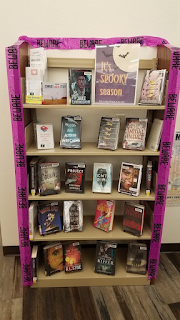
Putting books on display is my super subtle way of screaming “PLEASE TAKE THESE BOOKS, TEENS!” Sometimes it works, sometimes it doesn’t. I don’t have a lot of display space in my teen section (just one shelving unit and one small table) so I try to put some good thought into the displays I make. I leave the display up for a maximum of a month, but my real goal is to have a new display every 2-3 weeks. 

Most of my inspiration comes from looking at lists of books and checking to see if I have enough books in that category/genre/theme to make a display. For example, I might come across an article called “22 Books That Prove the Bond Between Sisters is Eternal” and think that a display about YA books featuring sisters would be a great display! Then I would check how many books on that list are currently available at my library and if there are enough to fill my display, we’re good to go! Next task is making a display sign, which I usually make on Canva. Most of the inspiring book lists I find come from Epic Reads, Book Riot, and Buzzfeed Books

In general, my teen book displays fall into one of the following three categories:

Seasonal Displays

Pretty self explanatory! I put out romance books in the weeks leading up to Valentine’s Day, horror/thriller books during October to get into the Halloween spirit, cozy winter reads before Christmas, and last September I featured books that take place at boarding schools. Don’t forget Black History Month and Pride Month! Don’t feel like doing a mainstream holiday? Look at the random holidays coming up, like on National Umbrella Day, put books on display that have umbrellas on the cover! 


Always Relevant 

You have got to have a few of these display ideas in your back pocket! These are displays that can be put up no matter the time of year or what’s going on in the world. The very easiest display is to simply pick a genre and put those books on display. It’s as simple as grabbing a stack of fantasy books and making a sign with a dragon and a sword! Rinse and repeat with all the other genres you can think of. Similarly, do a display featuring graphic novels or new releases.


Similar Covers

Another fun angle on this is putting books on display with similar covers. An easy one would be to grab books that have blue covers. Rinse and repeat with all the colors of the rainbow! You could also do books with people on the covers or books that have a person’s name in the title. Here is my display that featured duologies:


Viral Moments 

These are the displays you can’t do much to prepare for and are centered around the latest viral phenomenon/zeitgeist moment. Ask your teens about what’s trending! Similarly, displays can be made around the newest blockbuster movie or latest music album everyone’s talking about. For example, here’s a display I made last fall when Taylor Swift came out with her version of Red. 

When all anyone could talk about was Noodles the Pug and whether or not it was a Bones Day or No Bones Day, I made a quick and easy display on it. 

These are the hardest kind of displays to make and we’re all bound to miss some viral moment (or discover them embarrassingly late). My only advice is to pay attention to what your teens are discussing the most or, when in doubt, just ask them!   

We're always looking to connect with other young adult services librarians in WI! If you, or someone you know, wants to join our monthly meetings, please contact Taylor Wilcox at twilcox@waupacalibrary.org.

Thursday, September 2, 2021

Writing With Patrons

Braelyn Dempsey, Algoma Public Library, Algoma, WI is a member of our Wisconsin Teen Librarian Services Group. She shares her experiences with running a Creative Writing program in her library.

Programming can be hard, though the task sounds simple on paper: “Make a fun and engaging program for your age group.” As many Librarian’s know, there is a lot to compete with in patron’s calendars:
  • Football Games
  • Dentist Appointments
  • Night Shifts
  • Lack of a Babysitter
  • Last Minute Homework Crunch
  • Volunteering
  • and more…
That being said, there is one program that I have had personal success with: Creative Writing.

The program only happens once a month for two hours.

The first hour is dedicated to writing. I usually put on some instrumental music (my personal favorite is ukulele or piano playlists) to help everyone focus. On the table, I’ll have blank sheets of paper, a container of pencils, a container of pens, and a variety of writing prompts (for those that need a little inspiration).

The second hour of the program is for sharing. Anyone taking part can share the piece that they wrote during the previous hour (though a lot of patrons choose not to because they want to refine it more) or they can bring a piece/story they are working on and share that.

For newcomers, I always have a few key rules: -This is a safe space for individuals to be creative. Please respect other writer’s privacy and do not discuss what has been shared with other people that are not in the group.

  • This is a place of respect. Please come into this experience knowing that someone in the group might not have the same ideas, beliefs, or experiences as you. If you have nothing nice to say, don’t say anything.
  • This is not a class. No matter how comfortable or familiar you are with writing, you are not doing any of this for a grade. We are a community of writers that are here to write, share, and support one another.

These rules, so far, have worked wonderfully. Anyone taking part knows immediately that I value and care for every voice that is willing to share with us and that I will protect the “vibe” of the program at all costs. I have absolutely no issue asking anyone wanting to be rude or condescending to vacate the program and never come back. Thankfully, I haven’t had to do that yet.

The “scary” part (but the part that I love the most), is that I, as the facilitator, will also write and share during these programs. (As a rule, I always share last and am the one we can skip if the sharing portion of the program goes too long.) I know that not everyone might be comfortable with the idea of that: “I don’t like to mix my personal and professional life”, “I don’t feel like I have anything worth sharing”, “I am not a strong writer, myself.” It’s okay if you identify with any of those statements, however, I think the connections that our patrons make with each other, and with us as librarians, is well worth it.

Additionally, there is nothing say you HAVE to share a supremely revealing or traumatic piece during this session. If anything, it’s nice to just have a couple hours a month that are set aside to write and bond with patrons instead of the hustle/prep/cleanup involved with more complex programming.

That being said: I have done two different variations of this program: one for teens, and one for adults.

Despite the fact that I struggled to get the teens to come (a well-known librarian struggle), the one teen that previous attended consistently has continued to use the library and has stayed connected with me (personally) even though they aren’t a “teen” anymore.

The adult version of this program has been the most requested program of mine to come back since the March 2020 shutdowns. The adults that took part have said that they loved having a time and date where they knew they could set some time aside for writing, and the connections they made with other members of the community have lasted (despite not being able to take part in the program) because of the pieces they shared together.

As a group, we have laughed, cried, winced, and sighed together. We have shared pun-filled retellings of classic fairytales, early drafts of screenplays, and heart-wrenching recaps of real near-death experiences. Every story they bring to the group, every piece of themselves that they open up, makes our library and our community stronger. They are able to see each other as individuals with complex backgrounds and experiences, instead of a passing face on the way to the Circulation Desk. And, for the librarian that is willing to participate and share, it allows our patrons to see a different side of us that isn’t tied to a reading recommendation or library service. Thankfully, more often than not, my main role as the Librarian is to keep track of the time so that everyone gets to share, since conversation often happens so warmly around pieces that it’s easy to not want to watch the clock.

I’ll be the first to admit: on paper, this is not my most successful program. Like I mentioned before, I only had one teen regularly coming. For the adult version, it averaged out at about six patrons coming every month. For a Library that services 3,100 people in a county with only two libraries, those aren’t numbers to write home about. When it comes to the quality of the program, however, they have been the best.

So, I guess if you were to ask me what my main point of writing this is, I would have to say: Write with each other.

The writing doesn’t have to be great (it doesn’t even have to be good), but the effort of sharing a piece of your life/your story/your heart won’t be forgotten. I mean, we’re librarians… We, more than anyone, know the value of some solid character development.

We're always looking to connect with other young adult services librarians in WI! If you, or someone you know, wants to join our monthly meetings, please contact Taylor Wilcox at twilcox@waupacalibrary.org.

Saturday, August 28, 2021

Deep Breaths, Everybody…Stress S.O.S. Care Kits for Teens

Caitlin Schaffer, Oconomowoc Public Library, Oconomowoc, WI is a member of our Wisconsin Teen Librarian Services Group. She shares her experiences with programming and creating Stress S.O.S. Care Kits in her library.

So, Spring of 2020 happened and opened the floodgates of virtual programming.

Which flowed into summer...which smashed into fall. 


And somewhere along the way, I had a realization: Teens were sick of staring at me through a screen. I wasn’t actually providing a service to my teen library users by trying to create a packed schedule of trivia, Jackbox, and online meetups. Were some of those events appreciated in that they provided some source of socialization? Sure, for a time and for some of the most dyed-in-the-wool library teens. But I was starting to get the general impression that, outside of my core group of regulars, I wasn’t reaching or serving the teens of my community at a time in which they REALLY needed to be reached and REALLY needed to be served.

The crushing truth is that teens were and continue to be one of the age demographics most affected by the pandemic. One national poll conducted by the C.S. Mott Children’s Hospital in Michigan had almost 50% of parents reporting that they have noticed “a new or worsening mental health condition for their teen since the start of the pandemic.” 50 PERCENT. Mental health insurance claims for teens also roughly doubled in March and April of 2020 as compared to the same time in 2019, according to another study. So, while I would hope that my Digital D&D group was really helping a few people through, I am really doubting the reach of my efforts to teens during the spring and summer of 2020. 

What WAS reaching a lot of our patrons, I noticed, were our grab ‘n’ go activities and crafts. Until then I hadn’t put much thought into providing them for teens, not thinking enough were coming into the library to make it worth it. I did a little brainstorming with the help of teens on our Discord server, and the Stress S.O.S. Care Kits were born! (Yes, I know Stress.O.S. was right there, but when I looked it up another company was already using that term and I didn’t feel like getting served or something. Not on the top of my list. ANYWAY, MOVING ON.) I’m going to use SSOSCK to shorten that sucker for the rest of this post, because it’s a long name.

Initial Steps: My first thought was to reach out to the high school and see if they were already doing anything to support students’ mental health, or if they would be interested in having some of the SSOSCK available on location. After having a meeting with the principal and school’s psychologist, they decided they wanted to give creating their own Stress S.O.S. Care Kits a go, while simultaneously promoting mine and mental health resources in my collection. So, I really encourage reaching out to your community’s schools or other organizations that serve and support teen mental health to see if there’s a partnership opportunity there.

What soothes the teenage anxiety beast? A valid question to tackle as I considered what to include in the kits. I knew I wanted to make them available monthly, and that I wanted to put together at least 20-30 each month. There are ways to make them affordable, but if you’re talking at least six months of kits...that’s quickly going to add up. I consulted the oracle (Pinterest) by doing searches for things like “mental health care kit,” and I went straight to the source: I talked to my TAB, the teens on our Discord server, and my teen nieces and nephews. I also did the very tough task of soul searching: “What little things make me feel better when I’m stressed out and anxious?” Arduous work, but anything for the youth.

Turns out, the little things that give us a boost of endorphins are pretty universal:

· Chocolate

· Bubble wrap

· Tea and cocoa

· Fun stickers

· Fuzzy socks

· Chapstick

· More chocolate 


Little stuff like this, partnered with suggestions from therapists and others who keep calming items on hand for panic attacks, gave me a nice, long list to work off of. Small, simple things, paired with something that requires action, such as:

· A yoga deck

· Breathing exercises

· Mantras and affirmations

· Mood trackers

· DIY stress ball craft

· Etc., etc. (I’m happy to email my brainstorming list of items to anyone who wants them!)

Cost: The cost of each kit can vary depending on what you want to include. I usually had about 5-6 items in each kit, always including a Monthly Mantra and list of virtual resources for mental health assistance and suicide prevention. Some things I made in house, like the yoga deck, or I made use of stuff we already had around (Ex. We had a bunch of leftover mini-playdoh from summer prizes, so one month I included that and bought some playdoh stamps and tools from Amazon to add.). However, if I wanted to throw in mini-lotions, notebooks, socks, etc., those were usually purchased on Amazon or through Dollar Tree. I had quite a bit of wiggle room in my programming budget due to COVID and the lack of in-person summer programming, and I also used some local grant money as well. Depending on your funding and how many you make/how often you put them out, the cost might come more in the form of staff time versus dollars spent.

Le fin. I offered a monthly SSOSCK for pickup at the library once a month from October, 2020 through May, 2021 for a total of seven kits, 20-30 each month. I did not offer the kits in December or over the summer, as I was offering craft kits for teens at those times instead. The kits were always gone within the course of a week, often with some teens coming in within the hour after I announced each month’s kit on Discord. I always took a picture of the kit and its contents to post on social media, as shown:


While I decided against doing monthly SSOSCK this fall, I still intend on offering them seasonally, like over the winter to help with teens who deal with seasonal affective disorder and/or in the spring during testing and finals.

Do I deserve a Nobel Peace Prize for my efforts? Sure, if they’re just handing them out! But in all seriousness, it’s hard to feel helpless in the face of such a monumental catastrophe. It really, really sucks. We may not be therapists or counselors, but if one teen starts to feel the onset of a panic attack and can keep it at bay by remembering a breathing exercise, or if just for one bright, shining moment they feel a little bit better and a little less hopeless because they’re holding a warm mug of cocoa that we provided...worth it.


We're always looking to connect with other young adult services librarians in WI! If you, or someone you know, wants to join our monthly meetings, please contact Taylor Wilcox at twilcox@waupacalibrary.org.

Tuesday, June 8, 2021

Teen Programming: Best Practices

This post was created by Mark Zimmerman, Milwaukee Public Library, Milwaukee, WI is a member of our Wisconsin Teen Librarian Services Group. He shares some great advice about increasing your teen program attendance.

During my Research Methods course at the University of Wisconsin-Milwaukee this past spring, I chose the topic of “Boosting Teen Programming Attendance Numbers in Libraries” for my final project.

During the literature review portion of my paper, I compiled a list of best teen programming planning practices that might help boost attendance at your teen programs.

Here are a few tips and tricks from that research:

  • Use a mix of social media platforms (Facebook Live and Stories, Instagram, Discord, Zoom, GoToMeeting, YouTube, etc.)
  • Find ways to tap into the creativity, personality, and culture of your teen patrons
  • Be cognizant of digital divide issues and incorporate equity of computer and internet access when planning
  • Host tech programs and scaffold their tech skills by learning or improving new skills or concepts along the way; incorporate tablets, phones, websites, videos, podcasts, and other web-based resources
  • Engage with your library community to create funding opportunities and partnerships
  • Incorporate teens of all abilities, income levels, sexual orientations, gender identities, ethnic and religious groups, underrepresented groups, etc.
  • Try asynchronous, self-directed, or passive programming (coloring books, simple crafts, STEM/STEAM activities, take and make kits, etc.)
  • Advertise on social media, school announcements, newsletters, bulletin boards, posters, newspapers, radio stations, television, etc.
  • Create food-related programming (food tasting/cooking competition) or offer snacks during programs; when budgets permit, offer more substantial food options
  • Try programs that focus on relationships and social-emotional strengths and values
  • Build programs around workforce skills
  • Connect teens with peer-supported, interest-based, academically-orientated, production-centered opportunities
  • Combine age levels for intergenerational programs
  • Interview and/or survey teens; ask them what they want, expect, or need from the library
  • Advocate for teens so they will advocate for you and your library
  • Create Teen Advisory Groups (TAGs) or Teen Advisory Boards (TABs) to assist with programming ideas and planning; add structure/leadership to provide teens with opportunity and responsibility
  • Start with what works (opportunities for self-expression, pop culture tie ins, escape rooms, maker programs, gaming, trivia) and go from there; avoid programs that resemble school or provide little to no personal choice
  • Meet teens where they are without judgment
  • Don’t be afraid to experiment (or fail); you will learn either way
  • Face your unfounded fears by building alliances with teens; you’ll be glad you did

Having worked as a high school English teacher for nearly two decades, I’ve learned that teens are often misunderstood, yet can be staunch advocates once you build a rapport with them. By committing the time and effort to establish and cultivate connections and symbiosis with them, barriers between both groups (teens and teen librarians) can be lifted and teen programs with high attendance numbers can become a reality in your library. Try one (or several) of these suggestions for yourself. You might just be surprised by the results!

If you're interested in joining our WI Teen Librarian Services Group, please CLICK HERE for more information.

Thursday, March 4, 2021

3 Helpful Hints for Transitioning Your Programs from Winter to Spring During A Pandemic


(Above Image: Example of a active passive program. A collaborative sticker puzzle from Stick Together.)

Hopefully, this doesn’t come too late for some of you. It’s important to make sure your programming is fun, free and innovative at a time when your teens are super stressed. Think of the MUST HAVEs as the cute accessories to your program planning. Here are some helpful hints for you to consider as you plan out your Spring programs.

Creative Communication: Paper flyers are an awesome way to get the word out about your programs but you should consider using all of your social media options, because you never know which one your community of teens and parents might prefer to use communicate with you. MUST HAVE – A direct email for teens and their parents to communicate with you.

Active Passive Programs: Yes you can still program for your teens safely. DIY programs can be packaged creatively and provided by any library that has curbside service. You can organize scavenger hunts within your library or with community partners to get your teens out and about. Interactive displays (which can be virtual) that allow your teens to not only find great books but leave you their thoughts on the titles are also fun. MUST HAVE – Fun. Research this concept till you smile and you will find the right program for your teens.

Get Out(side): Partner with your parks and rec department and start using the outdoor spaces provided to your teens. Don’t be afraid of the cold- your teens aren’t afraid of wearing coats to hang out with their friends. If it’s at least 50 degrees and you can use open air shelters, consider doing programs in your local parks. You might consider sending out a survey to assess the social media platform that your targeted demographic might want to use. MUST HAVE – Get outside and walk your local area, this will let you see your community from your teen’s perspective. Change your paradigm and see your community from your feet.


 Alicia Woodland - McMillan Memorial Library- Wisconsin Rapids, WI 

This post was made by a member of our Wisconsin Teen Librarian Services Group.

Thursday, February 4, 2021

Scribe Tribe: A Creative Writing Rollercoaster


Starting a creative writing club for teens was something I was pretty nervous to do. Creative writing was never a strong talent of mine but there was a need for it in my community and with the encouragement of my director, I started planning Scribe Tribe. I had a vision of teens working around our community room, papers spread out on tables, teens brainstorming in the corner with friends and getting inspired at the library. That was in The Before Times. Once the world shut down and no programs could be in-person, the Scribe Tribe creative writing club became a virtual event held over Zoom as part of our SLP. Turns out, this change was for the better.

The plan was for Scribe Tribe to meet every week for an hour on Zoom from mid-June to mid-August. I was extremely dubious that a creative writing program would translate to this virtual format but I was proved wrong and Scribe Tribe became one of my most successful programs of the summer. 

Each session generally included a warm-up game, a short lesson about a writing topic, discussing the writing prompt, silent writing time, and optional sharing time. Let’s break that down:

Warm-up: I found it really helpful to have a warm-up game to get the teens to turn on that creativity switch in their brain and get them comfortable in the (virtual) space. We would play MadLibs to get them thinking about word choice. I tried other word games, with only mild success (these games would be much better in person). The most successful warm-up was based on the game What Do You Meme? This game works much like Apples to Apples except with meme pictures. I do NOT recommend buying it for your library as it very much R-Rated! But I happened to own it myself so I would hold up one of the (appropriate) meme cards and the teens would have to come up with their own captions. For example, I’d hold up a picture of a sad looking cat and the teens would come up with a caption like, “that feeling when you can’t see your friends because of quarantine.” Another successful warm-up was having the teens write a story one line at a time in the chat function on Zoom. That story ended up going in about a million different directions but the teens were cracking up! 

Writing Topic & Prompt: Never at any point did I want the teens to feel like I was their English teacher and they were in class. When we’d talk about aspects of creative writing like theme, plot, setting, character, etc., I always kept it broad and tried to relate it back to a story they knew. It would usually tie-in with that day's writing prompt. For example, when talking about plot, we used this Random Plot Generator (or this one) and they had to map out a story based on their results. The same applied to writing about random characters. To get them thinking about setting, teens picked a place off this list and wrote about life there. I also gave them visual prompts and question prompts

These prompts were a great stepping-off point and gave each Scribe Tribe session structure but as the weeks went on, the teens used the prompts less and less and instead wanted to work on their own stories. 

Writing and Sharing: This is what the kids really wanted, designated time to write, and I gave them almost half of our hour long program to do it. I would ask them to mute themselves on Zoom, with the option to unmute themselves if they had a question. Occasionally I would find piano music or video game music (which is designed to help you focus) on YouTube to play while the teens were writing. When that time was done, I would leave the last 5-10 minutes of the program for them to share what they wrote. Every program I would emphasize that it was completely optional and I never forced anyone to share. That being said, almost every teen wanted to read their work outloud to the group. I think this is where having Scribe Tribe on Zoom was actually an asset. It was much less intimidating for them to read in front of their peers on a video call as opposed to reading in person. 


By the end of the summer, I was so impressed with my regular group of 6-7 teens! The stories they wrote were so creative and I was so proud everytime they would choose to be vulnerable and read their story out loud to the group. I wanted to reward my dedicated teens with an author visit! Many expressed interest in becoming published authors someday and had a lot of questions. After doing research and asking around, Melissa Carollo at the Sun Prairie Public Library put me in touch with YA author Geoff Herbach. He enthusiastically said yes! The teens absolutely adored him and thought he was just hilarious! He gave them great advice, answered questions, explained to them what it takes to get a book published, and told some funny stories along the way. It was a fantastic experience!


When the new school year rolled around and fall programming started, I didn’t hesitate to add Scribe Tribe to the lineup. I felt that it was so successful during the summer and guessed that the teens would want to keep the ball rolling during the school year. I was sorely mistaken. Out of everyone, only one teen returned to the weekly fall session. I kept it going for that one person, mostly because he just wanted time to write and read his story out loud to me to get feedback. I didn’t talk about any themes or give any prompts. While I was happy to help this one teen, I was disappointed the momentum of Scribe Tribe didn’t carry over (and the one teen also missed writing with his friends). As librarians, we never truly know why one program is successful while another one fails. My best guess is that, despite my best efforts, creative writing felt too much like homework which was unappealing during the school year. Scribe Tribe was fun while it lasted but this program is going on the shelf for a while and I hope it has a resurgence someday! 


 Abby Seymour - E.D. Locke Public Library- McFarland, WI 

This post was made by a member of our Wisconsin Teen Librarian Services Group.

Thursday, January 7, 2021

So You Want To Start A Bitmoji Library Space?


Our library is back to computer-use and curbside services only, meaning that our teen patrons aren’t able to come in and explore our collection the way that they normally would: Through browsing, cover admiration, and asking for recommendations from their Teen Librarian. On top of that, I’ve heard many of them say that they just don’t use or really know how to find new books by using our library catalog. I get it, and I’m sure I’m not the only one who’s heard this. But how could we help our teens browse through the collection in a way that’s appealing to them? How could we share new and exciting titles with them in a way that was engaging and appealing to them? 

Let's Get Started: 

Well, for starters, let’s take our Teen Spaces to a virtual format that’s visually appealing, interactive, and easy-to-use. One of my co-workers mentioned an article about libraries and classrooms using Bitmoji spaces for their patrons to explore their collections and I loved that idea! But where should I start? And what did I want to include in our virtual space? 

What Do I Need?:

To start, I needed a Bitmoji avatar, a Google Slides presentation, and a picture from my department that our patrons might recognize. I made myself a Bitmoji and started a brand new, untouched Google Slides presentation. Before organizing my page, I had to figure out what would be necessary and helpful to my teens. I knew that this new webpage needed to offer my teen patrons access to our library resources, be easy to follow, and, while we were at it, promote our teen programs and activities.

Promote Your Collection!:

As I mentioned earlier, we’re limited to curbside services, so I needed to find the best way to show off our newly added books in our collection. When I took my background photo for the slide, I intentionally cleared off one shelf so I could use it to display my virtual collection. Then, I found images of each book that I wanted to display and pasted those on top of the bookshelf. After this, I manually linked each book image to their records in our library catalog so patrons can place their holds quickly and easily.

Don't Forget Your Programs: 

After the books were added, I added a few other details that I thought my teens would find useful. I added the image of a blackboard and on it I listed our catalog, and all of our current programs on it. I linked each program to their description pages on our library’s main website to save space on my Teen Room landing page. My Bitmoji also has a link that would take teens to a slide of my personal reading recommendations. And last, but not least, I inserted a video tutorial of how to use this interactive page and what’s all included on it.

Google Slide Formatting & Settings:

Once I finished creating all of my slides, I made sure all, but the main slide, were skipped. This allowed my Google Slides presentation to feel more like a webpage and less like a slideshow. Then, I clicked on the File button in the toolbar, and published my Google Slide presentation to the web. This is very important! It will make it so the link to your presentation opens up like a webpage/link as opposed to taking your patrons to a Google Slide presentation.

Keep It Simple and Engaging!:

Overall, I think it’s important to keep these interactive pages simple and fairly easy to explore, as they are still resource pages for your teen patrons. If there’s too much hidden, it can easily get overlooked or become too overwhelming for a patron. If you have the time, update it at least once a month and change up the books on your shelf so it’s new and engaging to your patrons. And while this method might be working for me, you can definitely customize your interactive page to best fit the teens (or other audiences) in your area best. You know them better than I do! Maybe you want to advertise your movie collection someway, or showcase a new service that your library is providing during these crazy times! That’s completely up to you and them.

P.S. Don't forget to share this resource with your school librarians as well! They might want to share it with their teachers, and they with their students.  

I hope this is helpful and if you ever have any questions, feel free to send them my way! 


Tools & Resources Used in Creating My Virtual Space:

  • Google Slides
  • Bitmoji (There’s an add-on you can use on your Google browser, but you may need to download the Bitmoji app on your phone/tablet to edit what your Bitmoji character looks like)

Want to see some examples? The virtual spaces featured below are from the Waupaca Area Public Library.

Thursday, December 3, 2020

Will Zoom Be The Death of Me?

by Linda Jerome, Teen Librarian, La Crosse Public Library

Honestly, some days it sure feels like it might, but that being said, virtual programming has also stretched me in ways that I would have never imagined. Is it sometimes painful? Yes. Am I still grateful? Yep. Prior to this year, I hadn’t done any virtual programming—zero, zip, nada. So when it was determined that we wouldn’t being doing any in-person programming for the rest of 2020, I was, in a word, shook. I’ve been working with teens for over twenty years and now here’s a whole new challenge and I had nothing but questions…how does this work? Will teens want to do virtual programs? How do we promote virtual programs? Does my face really look like that? And while virtual programming is far from perfect (especially for teens who don’t have the tools to access virtual programming) we felt that some programming for teens was better than no programming for teens and so started to learn everything I could. And that’s one of my lessons from this past year: sometimes you just gotta jump. Make those mistakes, feel stupid, rinse, repeat. It reminded me that learning new things is HARD and that it takes time (sometimes a lot of time) for things to start to feel easier. Being uncomfortable is OKAY and it will NOT kill me (I’m pretty sure this is true).

Another thing I (re) learned this year was about authenticity. When I first started virtual programs, the camera made me feel like I had to put on some sort of performance for teens, like I had to only show my best side at all times. Not that teens expected that from me but I expected that from myself and that kind of pressure was not only unhelpful but unnecessary. I had to remind myself that being authentic with teens is really the only way to connect with them, to build those relationships, no matter if we are in the same room or on Zoom. And with this new format, that meant admitting when I didn’t know how to do something or not being able to figure when something wasn’t working the way I though it should. And when I did that, I started to enjoy virtual programs almost as much as I did in-person programs because while the format was different, the connection was still the same.

Now that I’ve been doing virtual programming for six months it has given me a new way of thinking about programming. Once we’re back to doing in-person programs, how can we use virtual formats to include more teens? In the future we will be using more of a hybrid approach to programs, meaning we’ll either livestream and/or record our programs for teens who can’t make it to the library but still want to participate. As you already know, teens are incredibly busy humans and so being able to provide them with another option to participate in our programs is THRILLING! And to be honest, I probably wouldn’t have ever considered doing this if it hadn’t been for the events of the past year. So, yes, this year has been terrible in so many ways, but there have also been a few “silver lining” moments and I don’t know about you, but I’m going to hang onto those for dear life.