Showing posts with label families. Show all posts

Sunday, January 26, 2025

Take Your Child to the Library Day - Feb 1

Begun in Connecticut in 2011 by a children's librarian, this advocacy effort supports a strong informational webpage with a video, information and tips you can use in encouraging families to come to the library. Whether celebrating the day or not, the information is great!  If not in your programming plans this year, keep this in mind for next year! The following is from the project's website:

Take Your Child to The Library Day - February 1, 2025

On the first Saturday in February*, thousands of libraries across the world celebrate Take Your Child to the Library Day by offering free, fun, fabulous activities for families. Your local library is an ideal place for children to play, discover, make friends, and have fun. And Take Your Child to the Library Day is the perfect time to discover some library magic. From magicians to craft programs, ice cream socials to storytimes, each library offers something unique and delightful.

Visit your library’s website or give them a call to see what they have planned. Then mark your calendar for Take Your Child to the Library Day. Stop in for a visit. Enjoy the activities. Get a library card (they're free!), meet your children's librarian, and explore all the wonders that your local library has to offer your family. And be sure to stop in again soon – because every day is a great day to take your child to the library.

*Your library may choose to celebrate on an alternate day in February.

Thursday, December 5, 2024

UW-Madison iSchool Spring Youth Courses


There are some great youth librarianship courses planned by the iSchool's Continuing Education Department this spring. These are great ways to add to your library knowledge and skillsets from your home  office or home. 


Sustainably Grow Your Summer Library Program
February 10 - March 9 (4 weeks)
  • Online/asynchronous
  • $165 (Register 2 weeks early for 10% off)
  • Instructor: Dawn Tevis, La Crosse County Library
Looking for ways to keep your Summer Library Program (SLP) energized and relevant? This course will help you rework your programming in accordance with ALA’s sustainability guidelines, bringing environmentally sound, economically feasible, and socially equitable policies to your library. Learn how a sustainability mindset and the unique characteristics of your community can transform your SLP endeavors and bring resilience, potential, and change to your community. Then apply this knowledge and a wealth of ideas to develop a program that will fit into your upcoming summer library program plan.

Learning outcomes: 
  • Understand the history and purpose of SLPs
  • Explore sustainability as a core library value and its impact on your SLP strategy
  • Evaluate the unique characteristics and possibilities of your location to determine innovative programming possibilities and partnerships
  • Create a sustainable summer program plan rooted in your community’s needs to help ensure your SLP thrives now and into the future
This class is ideal for youth librarians and staff in both rural and urban areas who are new to the field, as well as those who have experience and want to re-energize themselves and their work with current sustainability-based best practices and innovations.  

For more info and to register, click here.


Connect and Engage: Effective Youth Outreach Strategies for Libraries
Feb 17-March 30 (6 weeks) 
  • Online/asynchronous
  • $275 (Register 2 weeks early for 10% off)
  • Instructor: Brooke Newberry, La Crosse Public Library
Are you looking to reach a wider youth audience and engage the underserved community? In this course, we will focus on effective outreach strategies, tips and tricks, and essential tools to connect with the youth community. These include tools on how to evaluate your patron population, conduct a needs assessment, and form meaningful new partnerships in your community. Join us to learn how to create engaging, inclusive, and impactful programs that resonate with today’s youth.

By the end of this course, learners will: 
  • Understand youth needs and trends
  • Develop effective outreach programs
  • Utilize new engagement strategies
  • Form strategic partnerships
  • Evaluate and improve outreach efforts
  • Implement sustainable practices
This course is designed for any library worker looking to expand their outreach services or get a better understanding of outreach best practices for youth. 

For more info and to register, click here.


Playing Around: The Library’s Role in Playful Learning for Young Children
March 31 - May 11 (6 weeks)
  • Online/asynchronous
  • $275 (Register 2 weeks early for 10% off)
  • Instructor: Kelsey Johnson-Kaiser, St. Paul (MN) Public Library
Play and learning are two sides of the same coin. Young children learn essential skills through play, yet access to play and play spaces is being reduced across the country. Libraries can serve a critical gap in any community by offering opportunities for free, safe, fun spaces that allow children and caregivers to play together. This course explores how to positively impact access to play and help children ages 0-5 thrive through a combination of theory-based learning and practical tools. We will focus on research about play and the ways play influences literacy; building a play culture in your library; and creating high-quality play spaces in a library of any size and any budget. Participants will emerge with an understanding of the ways libraries can support play and how to make change at their own institution. 

Learning outcomes:
  • Understand of the importance of play for children’s healthy development
  • Understand and be able to articulate the role of libraries in supporting playful learning
  • create a basic play philosophy for their libraries
  • Develop a personalized play plan for their libraries
  • Identify sustainable strategies for play space maintenance
Who should take this class?  Staff who serve youth ages 0-5 in public libraries.

For more information and to register, click here.


Creating a Welcoming Space for Immigrant and Refugee Families
April 7 -May 4 (4 weeks)
  • Online/asynchronous
  • $165 (Register 2 weeks early for 10% off)
  • Instructor: Jacqui Kociubuk, UW-Madison iSchool PhD Candidate
While immigrant and refugee children and families are a growing presence in many of our communities, it is difficult to know how we can best serve them. Through this course, you will learn about and explore best practices for cultivating a welcoming space and supportive library services to immigrant and refugee children and families both in and beyond the physical library walls.

Learning outcomes:
  • Understand how to create a welcoming library space for immigrant and refugee families.
  • Explore strategies for cultivating trust and building relationships between immigrant families, the community, and the library.
  • Learn best practices and approaches for providing services, resources, and programs to immigrant and refugee children and families.
  • Identify and assess opportunities for community partnerships to help expand and support services to immigrant and refugee families.
This course is designed for library staff who are interested in learning more about how to connect with and design library programs, services, and resources for children and families who are New Americans, immigrants, and/or refugees.

For more information and to register, click here.


  • Online & Self-paced
  • Cost: $100.00
  • Tutorial Designer: Layla Coleman
The number of literacies that individuals are being asked to establish and maintain in order to participate in today’s society continues to change and grow. With the advent of new literacies and shifts in the ways that schools are teaching foundational measures of literacy, what is an information professional to do? This course overviews the wide array of literacies that anyone working in library or youth spaces may need to understand, teach, or create programming around. These include but are not limited to: school-based measures of foundational literacy (including “leveled readers”, the science of reading, and balanced literacy approaches) and digital literacy, media literacy, and information literacy.

In this tutorial, learners will
  • Explore the origins of foundational literacy (the abilities to read, write, and communicate) and identify how foundational literacies are frequently approached in school settings.
  • Examine how children and youth establish digital literacies and media literacies.
  • Consider the social and cultural factors that impact literacies and how libraries can be influential in literacy development.
  • Discuss how information literacy guidance and programming has changed in library and education spaces.
  • Reflect on the different ways that literacy learning intersects and connects with your own library’s needs, resources, and programming.
This is a self-paced course that will be available for access as soon as you register. You have up to one year from your registration date to complete the course.

You will automatically receive instructions for setting up your account after you register. Once your login information is set up, please access the course at http://canvas.wisc.edu.

For more information and to register, click here.

Wednesday, August 28, 2024

New Inclusivity Webinar Resource - Part 1

In a recent blog post (the first in a series of three) on IFLS' Keeping Up with Kids blog, Leah Langby shared a great webinar resource from U-Kentucky's Human Development Institute. Entitled "More Than Welcome: Libraries serving families of young children with disabilities", the webinar contains practical tips as well as a downloadable guide, and assessment tool.

Leah writes:

  • Libraries are already doing a LOT of things well!
  • There is a gap in other opportunities for kids with disabilities in rural areas, and libraries can fill that gap! You don’t have to have specific programs or tons of space and money in order to make your programs and spaces more inclusive of kids with disabilities and their families.
  • The team created a wonderful self-assessment tool: Inclusive Library Spaces and Programs Self-Assessment to check out.
In this first of three blog posts, Leah goes on to summarize the tips from one of the key areas that the webinar covers. You can read the full first post here [Serving Families of Young Children with Disabilities. Langby, Leah. Keeping Up with Kids blog. August 26, 2024].

To access the final two Keeping Up with Kids summary posts on this webinar, please stop here.

Friday, April 9, 2021

An Early Childhood Podcast: The New Neighborhood

 From the Center for the Study of Social Policy Strengthening Families Project comes a new podcast as excerpted below from their eNewsletter on Tuesday, March 30, 2021.


CSSP Launches Early Childhood Podcast: The New Neighborhood
The New Neighborhood is a limited series podcast hosted by Joan Lombardi, exploring some of the dramatic changes taking place across the country as people work to reinforce a sense of community, support young children and families, and work to build equity within communities. Each episode features emerging innovations that will create a society where all children and their families can thrive. Three episodes have been released so farlisten now!

Thursday, December 12, 2019

Guest Post: Letters to Santa Program

Guest Post: Katelyn Noack, Mondovi Public Library

What is the program?
Pretty straightforward, it is about having kids (or anyone) write a letter to Santa! Only, Librarian’s KNOW Santa and have been promised that every child will receive a personal response from the North Pole. Pretty cool.

How did you come up with it?
A few years ago, I learned that the United States Postal Service (USPS) does a pretty cool thing where you can mail Santa letters ‘to the North Pole’ AKA Alaska, and the post office will postmark them from the North Pole and mail them back. So instead of your letter having a beautiful stamp saying it was processed in St. Paul (or wherever) it came FROM the North Pole. I wanted to take advantage of this program because I knew it would basically only cost me postage. For all the mailing information please see the link to the USPS website. It includes where to mail the letters and HOW to mail the letters.

Quick Background on Previous Years
I have done Letters to Santa for about three years now. The first time it was done directly after Story Time and I mainly had a bunch of blank papers with foam stickers and crayon on it. Live and learn. Then the next year I have Letters to Santa as an all-day drop in station. I designed some fun paper for the attendees to write on and left out instructions. It went well and we had about 30 letters turned in (large for our town!). However, after the program I received feedback from a few participants that it didn’t feel very “special” or “magical” that they were by themselves writing these letters. I took that to heart and made the program more of an event this year, versus a “drop-in”.

What I Did This Year:
First off, I designed a form fill letter instead of a blank sheet. I had a hard time crafting individual responses to an orange crayon squiggle. I also created an optional blank page that could be attached to the letter if the attendee wanted to write more or draw a picture. I also created envelopes to match the letters. I designed everything on Canva and only had to purchase some blank envelopes (no letterhead). Pro Tip: For your responses, unless you LOVE the taste of envelopes, save yourself and get pull seal ones. Trust me. I also created a USPS mailbox out of a Baker and Taylor shipping box for the attendees to put their letters in to “mail them”.  (Blue paint and a hot glue gun)

To make it more “magical” and interactive I had a few other stations as well. There was a snack station and a craft station. For the snack station I made Jell-O jigglers (gluten free, dairy free, nut free, etc. free) out of green and red Jell-O and for the craft station I had the kids make stockings. I made a template and we printed out a bunch on white cardstock and the same number on red cardstock. Before the program the staff cut out all the stockings and they were paired up. The white when on top of the red and they were hole punched all around. Then for the craft attendees decorated the white stocking with crayons, and festive foam stickers. When they were done, they could “sew” their stocking together with yarn – yay for fine motor skills!

Finally, as our last piece of “magic” we had a special visitor come who was going to take the letters back to the North Pole with her! One of our Friends had an elf costume and volunteered to be at the event. It was a wonderful highlight (even if some of the itty-bittys got scared by the costume).

How did it go?
Unfortunately, it did not go well. We had about three families come, and a total of 7 letters turned in. It was a drastic change from the year before. However, the kids who did come had a bunch of fun!

What went wrong?
Here are a few of my theories:
  • It was the time. While the drop-in activity may have been “less magical” it gave families the flexibility to stop by when they could. This event ran from 3 PM to 4:30 PM and didn’t seem to work out for many people.
  • It was the week of Thanksgiving. Last year we did the program the first week in December, which worked well but I received feedback that some of the kid’s letters did not return until the day AFTER Christmas. (Hey, Alaska is far away!) So, this year I moved it up a week! But it just so happens that we had a late Thanksgiving and therefore the dates coincided, and the program was the Monday before the Holiday. Many people are too busy around the holidays for much extra and that also make have been a factor in low attendance.
Tips/Notes
  • If you want to save your hand, you can have the caregiver write a response to their tiny human or at least make them aware of the option.
  • Make sure you have a legible return address! I have three siblings all write a variation of the same return address. Yikes. You could have caregivers pre-address the envelopes too if you wished.
  • Supplies were paper (which we had), printing (lot of printing), self-seal envelopes (Amazon – 100 for $9.00),  yarn to stitch stockings (which we already had), foam stickers for decorating (Michaels – with coupon I think it was $2.50 for 150 pieces), Jell-O, and postage. This program is more time than cost.
Where are the printables?! GIMME GIMME
Click HERE for printables from this program

Thursday, September 27, 2018

Guest Post: Kitty Party!

Author: Sara Soukup, Head of Youth Services, Lake Geneva Public Library

When I saw Fancy Nancy: Oodles of Kittens, I knew I wanted to have a Kitten Party at the Library.  I knew our local Lakeland Animal Shelter did outreach at some of the other libraries, and so I emailed them to ask if they could bring oodles of kittens to my library in July.  They said they could, for FREE. On the day of the program, not only did their volunteers bring tons of kittens, but they also brought kitty corrals to keep them in, which we spread through the room. They brought litterboxes for the corrals, and little toys for the kittens to play with. Before the children came in, they cut the kittens claws, and wiped them down with cleaning wipes. Then the kitties were ready for their adoring fans.

And there were so many fans! I did TRY to have preregistration. I capped my program at 50 people. But, I couldn’t turn away little ones who really wanted to come see the kitties! I kept adding more and more families to the list. Not everyone who registers comes, right? Well, we ended up with all 60 people who had signed-up, and a few summer camps and daycares who had not! We had so many people that they couldn’t all fit in the open space I had carved out for seating during the story part of the program.

So, I split them into two groups. I told them that the daycamps and daycares would play with the kittens first. I invited the families to hang out in the Picture Book Room to wait. I assured them that in a half hour we would switch.

Before I let the families leave, I gave everyone the rules:
1.      Kittens are babies. We don’t want to scare the babies, right? So we have to be quiet. Use your inside voices.
2.      Also, we’re not going to freak out. If a kitty crawls out of its pen, just gently put it back. Like that one right there… During this part of the program the pens were full of kittens showing us how good they were at climbing.
3.      If a kitten scratches you, don’t freak out. Put the kitten gently back in its pen and find your grown-up. We have a first aid kit, and you’ll be fine. Remember, these are babies!

At first, the day camp/daycare children sat in chairs lined up along the walls, and the volunteers from Lakeland handed out kittens. They showed the kids how to hold them. My teen volunteers helped distribute the kittens. While the kids were rowdy, I didn’t see anyone mistreat the kitties.

When a half hour had passed, I had the day camps/cares file out, and the families came in. The parents helped their children hold the kitties. One mom asked me to help her 4 and 6 year old how to hold a kitten. This was the first time they had ever done such a thing. It was adorable to hear the kitten start purring while her daughter held it. Finally, near the end of the program, a father came up to me and said, “I signed the papers.” He had adopted one of the kittens with his daughter! “It fell asleep while we were holding it. It was too cute. We sent pictures to her mom, and everything.”

 When the program was over, Lakeland cleaned up everything. They put all the kittens back into their kitten carriers. They packed up the litterboxes and kitty toys, and folded up the pens. It was so simple and fast.

This program was such a success that I plan to host it again next summer, with a few changes, of course.
·         Registration: One sheet for families, one sheet for daycamps/cares. ONLY 50 people per sheet. And only those people who are on the list may enter.
·         Time: The program for families will be from 2:00 pm.--2:45 pm. The program for daycamps/cares will be from 2:45 pm—3:30 pm.
·         Program: Just kitten cuddles, no crafts or storytime needed

All in all, this was a great program. We partnered with another organization in our community. We had amazing attendance. Set up and clean up was a breeze. And baby kitties found forever homes.


Thursday, August 2, 2018

Sock Hop

Disclaimer: If you ask children what they think a "sock hop" is, you will be told 99 times out of 100, in descriptive terms, about a sack race.

I am in love with this summer's CSLP Libraries Rock theme.  I have gotten to do genre-themed storytimes (including musicals, sqeeee!), Teen Music Trivia, and tons of other delightful music-based programs.  But last Saturday I capped off July with an all-ages Sock Hop, and it was a blast!  Here's what I did:

1) Food - I had a local bakery do up some cupcakes to fit the Sock Hop color theme I had chosen (white, pink, teal), Pixy Stix, candy buttons, punch, chips, and popcorn.  I can tell you right now that the Pixy Stix and the candy buttons were the favorites of the bunch!

2) Crafts - I had out two crafts: Socktopus and Soda Jerk Hats.  The Soda Jerk Hats I bought plain and in bulk via Amazon, here, and let the kids decorate to their hearts content.  The Socktopus involved purchasing lots of socks with fun patterns, thread, poly-fil, and felt.  Check out the full Socktopus instructions here.


3) Playdough Station - I also set out a table of playdough in themed colors, with cutters and rollers.  This is a great younger sibling option when families with multiple age children attend our larger
programs.  It is also a good sensory experience.

4) Local Royalty - I reached out to my local pageant and requested one of this year's Butterfest royalty to attend the Sock Hop.  My request was granted and in our programming room I had Miss Sparta's Outstanding Teen doing a number of musical activities, including boomwhackers, musical chairs, hula hoops, and more.  There is just something about having a "princess" at an event that makes the kiddos go crazy!
5) Music - I had 50s music playlists playing in our Children's area (where the crafts and playdough were) and in the program room.  Everyone bopped along!

I also encouraged the kids to come dressed in poodle skirts/leather jackets or other 50s garb. Overall, the Sock Hop was a success, with families arriving early and staying late!  Rock n' roll really is here to stay!

Thursday, April 12, 2018

Role-Playing Games Beyond D&D

"If you ever tried to get into tabletop role-playing games—the kind where you sit around with character sheets, describing your actions and rolling dice—it was probably through Dungeons & Dragons. And if you’re sick of medieval fantasy, or you don’t care about fighting monsters, or you hate looking up stats on different charts, you might have walked away thinking “I guess I don’t like RPGs.” Which is a shame, because there are thousands of other RPGs out there." - Nick Douglas

Last week over at lifehacker, Nick Douglas shared a great article highlighting various role-playing games that are NOT D&D (Dungeons and Dragons).  While D&D is by far the oldest RPG, it is by no means the only RPG.  And any one of the multitude of RPGs currently available might spark a great teen event or even be a good fit for a family program.  Check out the full article HERE.

Tuesday, January 2, 2018

Welcome to the Library, Little One! Welcome Baby Swag

We all know it's never too early to start reading to a child...and, in that same vein, it's never to early to welcome little future readers to the world of the library!

Does your library offer some sort of Welcome Baby program?  One of the great things about a program like this is that it can be as simple or as involved as you like!

First, decide what you'd like to provide each participant.  At our library, each registrant receives a bag with book lists, bookmarks, a book for the new baby, a book for any siblings they may have, information about early literacy offerings at our library--including things like 1000 Books Before Kindergarten, story times, etc.--a few stickers, a greeting card welcoming the baby into the world and congratulating the family, and a small knit hat.


In order to keep costs down, consider partnering with local groups or businesses!  For example, our Friends group provides the bags and the books given away.  The knit hats were generously donated by our library's Knit & Crochet Club!  Often times, they're looking for projects...and baby things are typically quick knits and oh-so-adorable.

You can also look into partnering with a local clinic or hospital to help expand your reach.  Some libraries choose to provide the hospital with things to give to the parents while at the hospital, while others opt to include an invitation for the family and their newest addition to come in and get library cards.  Either option is great!  Just keep your budget in mind when you're deciding, as providing things to the hospital or clinic outright would lead to a much higher initial demand for the welcome materials.

Be sure to give credit where credit is due and include all participating groups, whether through a brief mention on a handout or tags, when distributing the materials.  Not only will it make your partners feel appreciated, but it also increases the sense of a community's worth of welcome and support for both the new child and their parents.


Tuesday, May 9, 2017

Family Media Plan Tool

Families looking for resources about managing their children's media use have an option that centers their family values in the decision-making process about what kinds of media and how much time their child should be spending online or with a screen.

The American Academy of Pediatrics launched a new online tool in conjunction with its latest recommendations on children and media use in October. Whether a child is in pre-school, high school or in between, the Family Media Plan tool can help parents define their own family guidelines for media use. The tool includes a media time calculator and is available in both English and Spanish.

Thursday, January 5, 2017

Noon Year's Eve Party


This year our library threw a Noon Year's Eve Party.  (Yep, you read that right, noon.)  For those not in the know a Noon Year's Eve Party is a New Year's celebration for families and children.  We celebrated ours on Saturday, December 31, from 11:00 - 12:30pm.  The major components of the party included:

Image may contain: one or more people, people eating, people sitting, table, food and indoor1. Countdown clock to countdown to NOON!  I used THIS one and just had it displayed on a laptop, but you could project it onto a wall if you have the option.

2. Plenty of snacks.  I offered the masses multicolored goldfish in tiny Dixie cups, fruit trays with dip, cookies, Ritz crackers with cheese cubes, and sparkling white and red grape juice.
Image may contain: 1 person, sitting, table and indoor
3. Crafts!  The kiddos (and some grown ups) made Noon Year's Eve crowns and tambourines.

Image may contain: 2 people, people standing and indoor4. Bubble machine with lots of bubble mix.  I purchased THIS one and THESE extra bubbles.  It was such a hit!  We did have to put ours on a large towel after a bit, because it can get a little slick on the table.  I would advise, if possible, putting this up higher than we did, as some kids wanted to touch the machine/where the bubbles came out.

5. Balloon drop at noon.  This was the scariest (for me) part of the whole shindig.  I was obviously worried that it wouldn't work, that the net wouldn't release, that the balloons would be static-stuck to the ceiling, etc.  HOWEVER, this was a smash with the kids and parents!  And, I got to send a bunch of the balloons home with families, helping with the overall cleanup.  Tips: I built my own net system and it took about a day, so plan for that, or just purchase one of the many options available on Amazon.  Buy a hand balloon pump, trust me.  Two words: Static Guard, I sprayed the net with it (and some of the ceiling), before filling with balloons.
Image may contain: 9 people, indoor
If you want to know more details about how/why I built my own net system for the balloon drop, feel free to contact me!  Happy Noon Year!

Thursday, May 26, 2016

Let's Talk, Read, and Sing about STEM!

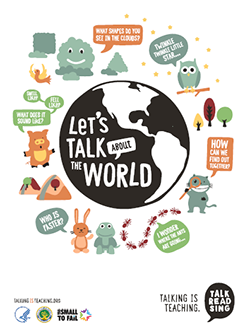
The U.S. Departments of Education and Health and Human Services and Too Small to Fail have created a set of early STEM resources for families and educators of young children entitled Let's Talk, Read and Sing about STEM!  These tip sheets provide fun, concrete resources and recommendations for families, caregivers, and infant, toddler, and preschool educators on easy ways to incorporate STEM concepts and vocabulary into everyday routines, and suggestions for activities to engage young children in STEM learning.
The tip sheets and "Let's Talk about the World" poster are available in English and Spanish. 
To read more or to download these awesome tip sheets, click HERE.